

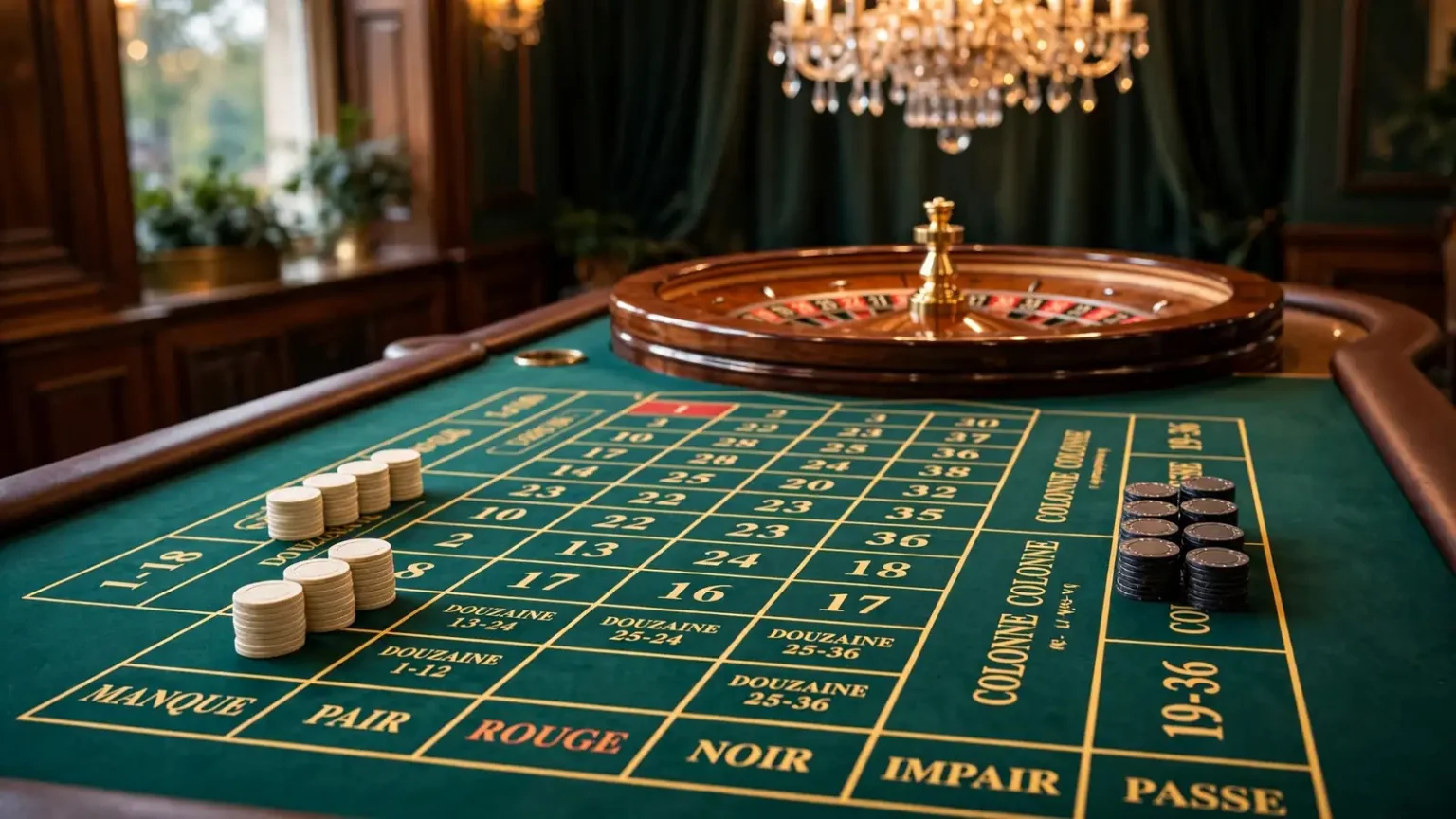
See how La Partage and En Prison affect eligible bets, alongside casino bonus terms, table limits and live, auto and speed formats.
French Roulette’s Zero Rules and House Edge
The key difference in French roulette is what happens when the ball lands on zero while you have an even-money bet on the table. Under La Partage, half of that stake is returned rather than the whole bet being lost. En Prison offers another way for an even-money wager to remain in play after zero. These rules reduce the house edge on eligible bets, which is why French roulette has the lowest house edge among standard roulette variants.
That advantage is specific to the zero rules and the type of bet you place. It does not mean every wager receives the same treatment, or that a spin is more likely to produce a particular result. If you are comparing French roulette at an online casino, the useful question is not just whether the game carries the French label. Check which zero rule applies and which bets it covers.
What La Partage does to an even-money bet
Even-money bets cover two broad outcomes: red or black, odd or even, and low or high numbers. If one of these bets wins, it pays as normal. If the ball lands on zero, La Partage changes the loss: instead of losing the entire stake, you get half back and lose the remainder.
That partial refund matters because zero would otherwise defeat both sides of an even-money choice. A bet on red loses to zero, just as a bet on black does. La Partage does not make the wager a winning one when zero appears; it limits the loss.
On the single-zero basis used for European roulette, the house edge is 2.70%. With La Partage applied to even-money bets, the edge on those bets falls to 1.35%. The distinction is important: the reduced figure applies to eligible even-money wagers, not automatically to every bet on the layout. A single-number wager, for instance, is not an even-money bet and does not receive the same half-stake refund under La Partage.
UK Casino Games: Slots, Live Tables and More
So if you choose a French roulette table primarily for its lower edge, match the rule to your intended wager. The benefit is clearest when you use bets that qualify for La Partage. A French title on the screen is less useful than a clearly stated rule.
How En Prison differs
En Prison also concerns an even-money bet when zero lands, but it handles the stake differently. Rather than returning half immediately, the casino holds the affected stake for another spin. The bet is effectively left unresolved: if the next result wins for your original selection, the stake is released; if it loses, the stake is lost.
That can feel less direct than La Partage because you do not receive an immediate partial refund. The stake remains committed while the next spin determines its fate. The precise handling of a further zero can depend on the table’s stated rules, so read the game information rather than assuming every online version treats that situation identically.
Both rules reduce the impact of zero on even-money bets, but they are not interchangeable in how they feel during play. La Partage gives you a known partial return as soon as zero appears. En Prison keeps the wager pending. Neither rule removes the house edge, and neither changes the random nature of the next spin.
What the lower edge does—and does not—mean
A lower house edge means the casino’s mathematical advantage is smaller under the stated conditions. It is not a forecast for an individual session. A sequence of spins can still produce losses, and the zero rules do not help a bet that loses on an ordinary number. They change the settlement of a qualifying wager when zero appears; they do not influence where the ball lands.
For a practical comparison, separate the table’s name from its rules. Confirm whether La Partage or En Prison is in force, whether the rule applies to your chosen even-money bet, and how the game explains a repeated zero under En Prison. Then compare the edge for the wager you actually intend to make, rather than treating the lowest figure as a universal property of every bet.
The lower house edge of French roulette is specific to the zero rules and applies to eligible even-money bets, not to every wager on the layout.
That is the defining appeal of French roulette: its zero rules soften a specific losing outcome. La Partage makes the reduction especially clear, while En Prison delays the decision on the stake. The advantage is real, but conditional. A smaller house edge is not a winning system.
How to Compare UK Casinos Offering French Roulette
Finding French roulette is only the first filter. A table can appear in a lobby while the operator makes key information difficult to verify, or provides account controls that do not suit the way you want to manage play. Compare each casino against the same criteria: legal status, game information, player protections and clarity of service. The right choice depends on which of those matters most to you.
Verify the operator before depositing
Online casino activity in Great Britain is overseen by the UK Gambling Commission (UKGC), the country’s sole regulator for this activity. Operators that offer real-money gambling to customers in Great Britain must hold the relevant UKGC licence, wherever the business is based. A site’s branding, a familiar game provider or a polished live-casino lobby is not proof of authorisation.
Look up the operator on the UKGC public register and check that its licence is current before depositing. Compare the registered business name with the name shown on the casino site; a mismatch deserves clarification rather than guesswork. Platforms without a valid UKGC licence cannot legally offer real-money live roulette to British residents. That is a basic suitability test, not a small-print detail.
Hi-Lo Casino UK: Online and Live Game Explained
Age verification is another practical checkpoint. Operators must verify a customer’s age before allowing them to deposit funds into a gambling account. A casino should explain what verification involves and make its requirements easy to find. If the site’s registration flow leaves you uncertain about how age and identity checks work, pause before adding funds.
Check that the game information is usable
For each French roulette listing, look for a clear game information panel or help page. It should identify the game and explain the rules that apply at that table, rather than relying on the word “French” in a title. If the table offers specific rules, they should be visible before you play. This lets you compare like with like without assuming that every game carrying the same label is configured identically.
RTP information should also be accessible. Check whether the casino provides the return-to-player information for the specific roulette game in its lobby, rules panel or linked game details. If you have to search through unrelated pages or contact support just to locate it, mark that down as a transparency weakness. The useful comparison is not which casino makes the largest claim, but which makes relevant information easiest to inspect and understand.
Do not treat a game’s presence in a catalogue as proof that its details are complete. Compare the operator’s explanation with the information shown when you open the game, and note whether the rules and RTP details remain available from the table itself. Clear information helps you make an informed choice; it does not predict an individual result.
Fast Payout Claims at UK Online Casinos
Compare player controls and recourse
UKGC-licensed live casino operators must provide deposit limits, loss limits, session time reminders, reality checks, cool-off periods and GamStop self-exclusion. Look for these controls in the account area and check that their descriptions are clear. Remote operators must prompt new customers to set a financial limit before their first deposit and provide accessible account-level limit controls. A casino that makes these tools hard to locate is less convenient to manage, however attractive its game selection may look.
Self-exclusion is not the only account safeguard worth checking. UKGC licensees must offer an internal complaints process and access to an approved Alternative Dispute Resolution service. Find the complaints instructions and the route to ADR before you need them. The terms should explain how to raise a concern and what happens if the operator’s own process does not resolve it.
Payment rules are part of the same check. UKGC-licensed casinos cannot accept credit cards for gambling. Operators also cannot accept wallet payments where the wallet allows credit-card funds to be used for gambling. Read the payment guidance rather than assuming that a familiar wallet or payment brand makes every funding route acceptable.
Use a consistent comparison
A simple table prevents one appealing feature from outweighing an important omission:
| Criterion | What to verify |
|---|---|
| Authorisation | Current UKGC licence on the public register; registered business name matches |
| Game details | French roulette rules and RTP information are easy to access |
| Account safeguards | Required limits, reminders, cool-off options and GamStop self-exclusion are available |
| Age checks | The operator explains verification before deposits are permitted |
| Complaints | Internal process and approved ADR access are clearly described |
| Payments | Credit-card gambling and prohibited wallet funding are not offered |
Use the same checklist for every casino you consider. One may make game information clearer; another may present account controls more plainly. There is no useful “best” label without a criterion. For UK casinos with French roulette, the stronger choice is the one that meets your priorities while making its licence, game details and protections straightforward to verify.
Compare Casinos by Bonus Wagering Terms
A French roulette table can suit your preferred game and still be a poor match for a bonus. The deciding factor is often game weighting: the share of each qualifying roulette wager that counts towards the wagering requirement. Compare that rule before treating a casino bonus as useful for roulette.
| Term to compare | What to check | Why it matters |
|---|---|---|
| Roulette weighting | The contribution rate for roulette wagers | A low rate means less progress for each qualifying stake |
| Game category | Whether live and RNG roulette have separate rates | The same bonus may treat the formats differently |
| Bonus type | Whether the rule applies to a welcome, deposit or no-deposit bonus | Conditions can change between offers |
| Exclusions | Whether particular roulette games or wagers are excluded | A game may be available but not count towards wagering |
The figures published across UK operators are not uniform. Most count roulette wagers at 10% to 20% towards bonus wagering requirements, while a broader comparison of operator terms reports live roulette at 10% or 20% and RNG roulette often at 100%. Those figures should not be read as a rule applying to every casino: the operator’s terms for the specific offer are what determine the weighting.
That distinction changes the practical value of a bonus. If you intend to play roulette, a higher contribution rate generally makes qualifying wagers count more towards the requirement than a lower one. But a rate alone does not establish which offer is better. You also need to know whether the bonus can be used on your chosen game, what the requirement applies to, and which conditions must be met before bonus funds can be withdrawn.
Read the game-specific wording
Look for the wording on roulette in the bonus terms, rather than relying on a general casino page or a headline offer. Check whether live roulette and RNG roulette appear as separate categories. If the terms give one rate for casino games but then list roulette exclusions or exceptions, those specific clauses are important.
Attention Check the specific bonus terms to see how much your roulette wagers contribute towards the wagering requirement, as rates can vary significantly.
No-deposit bonuses deserve particular attention. Some UK operators exclude live roulette from wagering on these offers; where it is included, a specialist review reports a contribution range of 0–10%. Treat that as a prompt to inspect the current offer, not as a standing rule across the market. A casino’s terms may differ between promotions, and an old summary may not describe the offer you are considering.
The same caution applies to named operators. A specialist review reports that PartyCasino and Gala Casino list live roulette at 10–20% contribution towards wagering. That is a reported description of their terms, not a promise that every offer at either operator uses the same rate. Check the conditions attached to the specific bonus before you opt in.
Compare progress, not headline size
A larger bonus can look attractive while offering little practical value for a roulette player if roulette contributes only a small share of wagering. Conversely, a smaller offer with more favourable game weighting may fit your intended play better. The useful comparison is between the actual wagering requirement and the contribution for the games you plan to play—not the bonus headline in isolation.
Do not assume that a high roulette contribution makes an offer easy to clear. Other conditions still matter, including the eligible games and the rules for using bonus funds. Nor should you assume that a French roulette label guarantees a particular weighting: the bonus terms may group the game with roulette generally, distinguish its format, or exclude it.
Fast Payout Online Casinos in the UK: Keno Explained
A specialist review states that UK bonus wagering has been capped at a maximum of 10x since January 2026. Because promotion terms can change and that claim is presented in a review rather than as a term of a particular offer, confirm the applicable requirement in the operator’s current wording. The cap does not tell you how much roulette contributes; game weighting remains a separate condition to check.
For a fair side-by-side comparison, record each offer’s wagering requirement, roulette contribution, format-specific exceptions and bonus type. Then judge the options against the roulette you actually intend to play. There is no single best French roulette casino for every bonus user: the stronger match is the one whose written terms count your chosen play in a way you understand and can assess. No headline can do that work.
Low, Standard and VIP Table Limits
A table’s minimum stake tells you the smallest bet it accepts, not the amount you need to stake on every part of the layout. For a low-stakes French roulette table, that distinction matters: you can place a small permitted wager without treating the table label as a recommendation to increase it. Compare the minimum with the amount you are prepared to risk over a session, then check whether the table’s other limits leave room for the way you intend to bet.
The available figures vary by format. A specialist review reports UK live roulette minimums starting at 10p, while auto-roulette and speed roulette can start at 5p. Treat these as reported entry points, not guarantees that every operator offers those stakes or that every French roulette table is available at them. The minimum shown in the game itself is the useful figure when you are deciding whether a particular table fits your budget.
Best Keno Online Casinos in the UK: How to Compare
Low limits: focus on the entry stake
If keeping each wager small is your priority, look first for the minimum stake rather than relying on labels such as “low limit”. A low-minimum auto or speed table may allow a smaller opening bet than a live table, based on the reported figures above. But the table’s name alone does not confirm its limit; check the specific game lobby and the table information before you start.
Also distinguish the minimum from the maximum. A table can accept a small opening stake and still impose a ceiling that matters if you want to vary your bets. Conversely, a high maximum does not require you to bet more. The relevant question is whether both ends of the permitted range suit your plans. If the minimum is already more than you are comfortable staking, that table is not a low-stakes option for you, regardless of its marketing label.
Standard limits: compare the actual range
“Standard” is a useful description, not a fixed stake band shared by every casino. Operators can set different limits, and two tables with similar presentation may not accept the same stakes. Compare the minimum and maximum listed for each table rather than assuming that a standard-limit French roulette game has a market-wide definition.
This comparison is especially useful when several tables offer the same variant. If one has a minimum that fits your intended stake and another starts above it, the first is the more suitable choice on entry cost. If you want flexibility to raise or lower your wager, compare the full permitted range as well. The better table is the one whose limits match your planned stakes—not simply the one carrying the more impressive label.
Do
- Check the specific minimum stake in the game lobby
- Compare the full permitted range of limits
- Set your own stake level based on your budget
Don’t
- Rely on marketing labels like “low limit”
- Assume a VIP table is appropriate for your budget
- Ignore the maximum stake ceiling
VIP limits: a label, not a reason to raise your stake
A VIP or high-limit table is relevant only if its permitted stakes suit you. The label does not make a table more appropriate for every player, and a higher maximum has no practical value if you do not plan to use it. Check the minimum first: a VIP table may begin above the amount you are comfortable wagering, making it a poor fit even if you like its presentation.
Set your own stake level before choosing a table, then reject any option whose minimum pushes you beyond it. This keeps the comparison anchored to your budget instead of the table’s status. A low, standard or VIP label can help you navigate a lobby, but the posted limits decide what you can actually wager. Check those limits every time you switch tables; the name on the tile is no substitute.
Live, Auto and Speed Roulette: What Changes
The main difference is how each spin is produced and how quickly the next one begins. If you are choosing a live French roulette casino, compare the streamed experience with automated play: the wheel may look familiar, but the pace, presentation and account safeguards deserve separate checks.
Live dealer: a wheel on camera
Live casino French roulette is streamed from a studio, where a human dealer spins a real wheel and releases a physical ball. You watch the action unfold rather than seeing a computer-generated result. The dealer’s presence and the camera view make this format more like a table game, while the time taken to place bets and complete each round sets its pace.
Live Roulette UK: English-Speaking Dealers and Site Checks
For a sense of the difference, the stated rate for live dealer American roulette is 50 to 60 spins per hour, compared with 150 to 200 or more for RNG American roulette. These are format comparisons, not a promise about every table: the game and its round timings matter.
Auto roulette: simulated spins
Auto roulette replaces the studio wheel with results generated by a random number generator, or RNG. There is no live dealer or physical ball drop. The software handles the spin, so rounds can move along more quickly. RNG games may also have lower minimum stakes, with some starting at 10p.
If you want a live auto French roulette casino experience, check what the label means on that specific game. “Auto” generally points to a simulated wheel, while “live” signals a streamed studio game; a casino’s own game description should make clear which format is offered.
Speed roulette: less waiting
Speed roulette is designed to shorten the time between rounds. A specialist review reports a rate of more than 150 spins per hour for speed roulette, compared with 80–100 at a standard table. Treat that as a comparison from that review, not a fixed pace for every game. The practical trade-off is simple: less time between spins can mean less time to pause and consider whether you want to continue.
Live Dealer
A streamed studio experience where a human dealer spins a real wheel.
Auto Roulette
Simulated spins generated by a random number generator (RNG).
Speed Roulette
Designed to shorten the time between rounds for faster play.
Choose by the pace that suits you, not by the highest spin count. A live wheel prioritises the studio experience; RNG prioritises quicker, automated rounds; speed roulette compresses the gap between plays. Faster is not automatically better. It is simply faster.
UK safeguards for live play
In Great Britain, the UK Gambling Commission (UKGC) is the regulator for online casino activity. A platform without a valid UKGC licence cannot legally offer real-money live roulette to British residents. Check the operator’s licence number on the UKGC public register before depositing, and confirm that the game is offered by the regulated operator rather than through an unlicensed service.
Operators must verify your age before allowing you to deposit. UKGC-licensed live casino operators must also provide deposit and loss limits, session time reminders, reality checks, cool-off periods and GamStop self-exclusion. New customers must be prompted to set a financial limit before their first deposit, with account-level limit controls available afterwards. These tools apply whichever live table you choose; they do not change the wheel or its pace.
Inside a Roulette Game: Pockets and Payouts
A roulette table brings the wheel’s pockets and the betting layout together. In European roulette, the wheel has 37 pockets: numbers 1 to 36 and a single zero. On an online French roulette table, you place chips on the numbered layout before the spin; the result is determined by where the ball lands.
The layout gives you several ways to cover outcomes. A chip placed directly on one number is a straight-up bet. Place it on the line between two neighbouring numbers for a split, or across the end of a row of three for a street. These inside bets cover relatively few results, so their payouts are higher than those for broader outside bets.
| Bet | What it covers | Payout |
|---|---|---|
| Straight-up | One number | 35:1 |
| Split | Two adjacent numbers | 17:1 |
| Street | A horizontal row of three numbers | 11:1 |
| Red or black | One colour | 1:1 |
| Even or odd | One parity | 1:1 |
| High or low | One half of the numbered range | 1:1 |
Payouts are expressed as odds: a winning straight-up bet returns winnings at 35:1, while a split returns winnings at 17:1. The original stake is also returned on a winning bet. That distinction matters when comparing the odds shown on screen with the total amount credited after a win.
Outside bets sit around the numbered grid and cover broader categories, such as a colour, odd or even numbers, or high or low numbers. Their 1:1 payout is lower than the payout for an inside bet, but each covers more possible results. The zero is a pocket of its own, not a red-or-black, odd-or-even or high-or-low result.
Before confirming a wager, check that the chip is on the intended space. A chip resting on a number is not the same bet as one on the dividing line beside it; the first covers one result, the second covers two. On a digital table, the highlighted selection and bet summary are useful checks before the spin begins. Small placement difference, different bet.
On a digital table, always check the highlighted selection and bet summary to ensure your chip is on the intended space before the spin begins.
Matching a Casino’s French Roulette Offer to Your Needs
A French roulette table is a suitable match only if its format, stake conditions and rules fit how you want to play. Start by deciding whether you prefer a computer-generated game or a streamed table with a dealer. RNG roulette simulates spins and can offer faster play with lower minimum stakes; live roulette brings a real wheel and human dealer, but the experience depends on the table’s available limits and pace.
Then check that the specific game is French roulette, rather than assuming the label covers every roulette table in the casino. Look for the rules displayed in the game information and confirm whether La Partage and En Prison apply. A French-themed layout alone does not establish which rules govern the table.
Your available stake matters too. A specialist review reports UK live roulette minimums starting at 10p, with auto-roulette and speed formats sometimes starting at 5p; these are table-specific figures, not a promise that every casino offers them. RNG tables can also have lower minimum stakes, with some reported as low as 10p. Check the live lobby or game screen before choosing, since the displayed minimum is the relevant one for that table.
For a streamed game, confirm that the operator holds a valid UK Gambling Commission licence: a platform without one cannot legally offer real-money live roulette to British residents. If you want to use a bonus, inspect the game’s stated eligibility and wagering terms separately; an available table does not necessarily qualify.
The right offer is the one that fits your preferred format and lets you play within your chosen stake conditions. If either remains unclear in the game rules or lobby, treat that as a reason to keep looking.
What Premium Roulette Tables Actually Change
A premium French roulette table changes the conditions of entry, not the mathematics of the wheel. A higher minimum means you need to place larger stakes to join; it does not make a number more likely to win or alter what a winning bet pays. If the table uses the same French rules as a lower-stakes game, those rules still determine how zero affects qualifying bets.
Live Casino Lightning Roulette in the UK: What to Check
Keep three criteria separate when comparing a premium French roulette casino: the minimum stake, the format, and the rules shown in the game information. A polished studio or a higher table limit may suit your preferred experience, but neither is evidence of better odds. European roulette, for instance, has a house edge of 2.70%; the table’s premium label does not reduce it.
Entry points vary by format. A specialist review of UK tables reports live roulette minimums beginning at 10p, while some auto-roulette and speed games allow entry from 5p. Treat those figures as reported examples, not a promise that every operator offers them. Check the live table’s displayed limit before joining.
The useful comparison is therefore not “premium versus ordinary” in isolation. It is whether the required stake fits your budget and whether the table’s rules match what you expect from French roulette. A costly seat is still the same game underneath.
Playing Roulette Online Without Chasing Losses
A betting system can organise your stakes, but it cannot improve your ability to predict a roulette result. This distinction matters when you play French roulette online: the wheel’s next outcome remains a matter of chance, regardless of the bets placed before it.
The Martingale is a familiar example. After each loss, you double the next stake, aiming to recover earlier losses when a win arrives. The arithmetic sounds tidy until a losing streak stretches further than your available bankroll allows. Each step demands a larger stake, so a run of losses can consume funds quickly and leave you unable to continue the sequence. A system built around doubling is not a shield against losing. It concentrates more money on the next spin.
There is another limit: your budget is finite, while a streak has no guaranteed endpoint. Even if a win eventually comes, it may arrive only after the required stake has become unaffordable. The approach also does not change the odds of any individual result. It changes the size of your exposure, not the wheel.
Live Baccarat Online Casinos in the UK: How to Compare
Set a spending limit before you begin and treat it as a boundary, not a target to win back. If you reach it, stop rather than raising stakes to recover losses. A session limit can also prevent a short spell of play from turning into an open-ended attempt to reverse a bad result.
If you notice yourself increasing bets because you feel due a win, pause. No roulette system predicts the final outcome, and a previous loss does not make a particular result more likely next. The sensible comparison is not which system promises a recovery; none can promise one. It is whether a staking approach keeps your spending within a limit you can afford to lose.
The wheel keeps no score.
European, American and Three-Zero Roulette Compared
The pocket count is the quickest way to distinguish the main roulette variants. European roulette has 37 pockets: numbers 1 to 36 and one green zero. Its house edge is 2.70%. American roulette adds a double zero, bringing the total to 38 pockets and raising the house edge to 5.26%.
Live Blackjack Online Casinos in the UK: What to Check
That extra pocket matters because it gives the house another winning outcome. The American layout also includes a basket bet covering zero, double zero, one, two and three. Its house edge is 7.89%, making it less favourable than the standard American game. Check the table rules before placing a bet; the layout can affect the cost of a choice.
Some American tables add a third green pocket marked 000. A specialist review reports a 7.69% house edge for this version. Treat that as a specific table variation, not a description of American roulette as a whole. Three green pockets make a material difference to the odds.
French roulette uses a single-zero wheel, but its distinguishing feature is the availability of La Partage and En Prison. With these rules, it has the lowest house edge among standard variants. La Partage reduces the edge on even-money bets to 1.35%; the precise rule in force should be shown in the table information.
| Variant | Pockets | House edge |
|---|---|---|
| European | 37 | 2.70% |
| American | 38 | 5.26% |
| American basket bet | — | 7.89% |
| Three-zero American, as reported by a specialist review | Includes 000 | 7.69% |
If you are choosing between tables, compare the pocket layout and any special rules, not just the game’s name. Fewer green pockets help; French rules can improve the comparison further.