Understanding Online Roulette
Roulette’s simplicity is deceptive—understanding the odds takes more thought than spinning the wheel. A ball bounces around a numbered wheel, lands in a pocket, and you either win or lose based on your bet. That mechanical simplicity masks mathematical relationships worth understanding before you play.
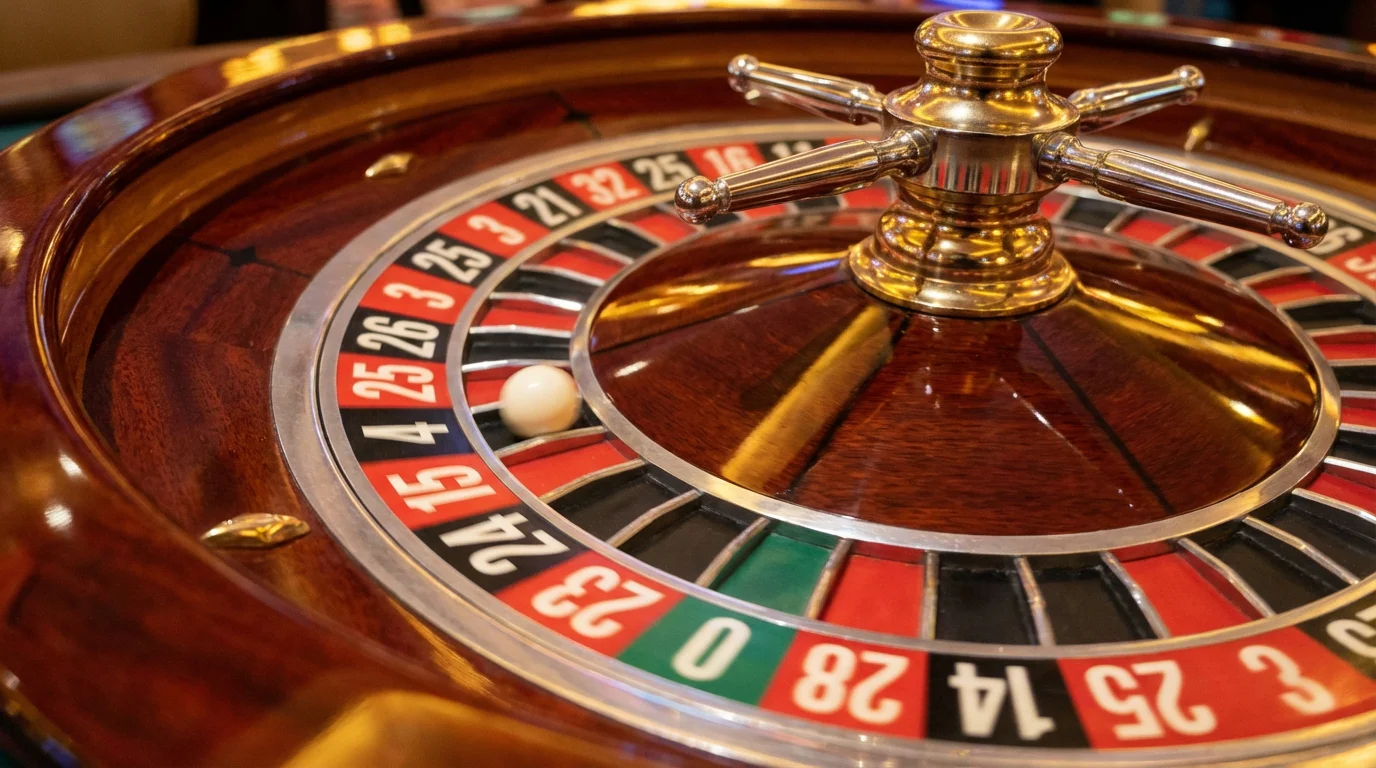
The roulette wheel contains numbered pockets from 0 to 36, alternating between red and black (zero is green). You place bets predicting where the ball will land—on specific numbers, groups of numbers, or characteristics like colour or odd/even. Payouts vary inversely with probability: safer bets pay less, riskier bets pay more. A winning bet on red returns 1:1, doubling your stake. A winning bet on a single number returns 35:1.
The house edge comes from the zero. Without it, the game would be perfectly fair—18 red numbers versus 18 black, 18 odd versus 18 even. The zero breaks this symmetry. When the ball lands on zero, most bets lose. That single pocket gives the house a 2.7% edge on European wheels. American wheels add a double zero, nearly doubling the house advantage to 5.26%.
Online roulette comes in two forms. RNG roulette uses random number generators to simulate wheel spins, producing results instantly with no physical wheel involved. The graphics recreate the visual experience, but outcomes derive from mathematical algorithms rather than physics. Live dealer roulette streams actual wheels spinning in real time from purpose-built studios, with professional croupiers managing the table. Both formats offer the same mathematical game; the difference is presentation and pace.
Each spin is independent. The ball has no memory of previous results. A streak of ten red numbers doesn’t make black any more likely on the next spin—the probability remains exactly 18/37 on a European wheel. This independence makes roulette impervious to pattern-based strategies, though it doesn’t stop people from trying.
The game’s enduring appeal lies in its combination of simplicity and tension. Anyone can understand the basics immediately. The moment between ball drop and final bounce creates genuine suspense. Neither requires skill or concentration. What skill does exist lies in a single choice that precedes any betting.
European vs American Roulette
Always play European roulette—it’s that simple. The difference between European and American wheels is one of the few genuinely consequential choices in roulette, and the correct answer is unambiguous.
European roulette uses 37 pockets: numbers 1-36 plus a single zero. American roulette uses 38 pockets: the same numbers plus both a single zero and a double zero. That extra pocket doesn’t increase your potential winnings—payouts remain identical. It only increases the house edge. European wheels give the house 2.7%. American wheels give the house 5.26%. You receive nothing extra for accepting nearly double the disadvantage.
Consider the maths on a simple red/black bet. On a European wheel, you have an 18/37 chance of winning. On an American wheel, you have an 18/38 chance. The payout stays at 1:1 either way. That difference of one additional losing pocket—the double zero—costs you 1.35% on every bet placed. Over an evening’s play, that compounds substantially.
UK online casinos overwhelmingly offer European roulette as the default, reflecting both regulatory expectations and player preference. American roulette exists at most sites but typically appears further down the game list. If you find yourself playing American roulette, it should be a deliberate choice rather than an accidental default. Given the mathematical penalty, few scenarios justify that choice.
French roulette offers a further refinement. It uses the European single-zero wheel but adds the “La Partage” rule: if you place an even-money bet (red/black, odd/even, high/low) and the ball lands on zero, you lose only half your stake. This reduces the house edge on even-money bets to 1.35%—half the standard European rate. French roulette tables are less common than standard European, but they’re worth seeking out if available. The visual presentation tends toward traditional elegance, appealing to players who appreciate formal casino aesthetics.
Some exotic variants exist—mini roulette with fewer numbers, multi-wheel roulette spinning several wheels simultaneously—but these typically carry worse odds than standard European. Treat them as novelties rather than serious alternatives. The fundamental choice remains straightforward: European or French for sensible play, American for unnecessarily expensive entertainment, everything else for occasional variety only.
Roulette Bet Types Explained
Every bet type has the same house edge—except on American tables. This counterintuitive truth means your choice of bet affects volatility and entertainment value rather than expected return. Understanding the options helps you construct a betting approach that matches your preferences.
Inside bets cover specific numbers or small groups of numbers. A straight-up bet on a single number pays 35:1. A split bet covering two adjacent numbers pays 17:1. A street bet covering three numbers in a row pays 11:1. A corner bet covering four numbers pays 8:1. A line bet covering six numbers across two rows pays 5:1. The probability of winning decreases as coverage expands, but the house edge remains constant at 2.7% on European wheels.
Outside bets cover larger groups with higher probabilities but lower payouts. Red/black, odd/even, and high/low (1-18 or 19-36) all pay 1:1. Dozens (1-12, 13-24, or 25-36) and columns pay 2:1. These bets win more frequently but return less when they do. Again, the house edge stays at 2.7%. You’re not getting better odds by playing safe—you’re getting different variance patterns.
The maths works out identically because payouts precisely reflect probabilities minus the house cut. A single number has a 1/37 chance on a European wheel. Fair odds would be 36:1; actual odds are 35:1. That difference—the missing unit—is the house edge. The same calculation applies to every bet. Columns win 12/37 of the time; fair odds would be approximately 2.08:1, but actual odds are 2:1. The gap is consistent.
Betting strategy, then, becomes a matter of preference rather than optimisation. High-volatility players prefer inside bets: lose more often but win big occasionally. Low-volatility players prefer outside bets: win frequently but never dramatically. Most players spread across both, placing an anchor outside bet supplemented by speculative inside bets. No combination changes expected return; all combinations average out to 2.7% loss over sufficient spins.
Some players pursue “covered” strategies—placing enough bets to guarantee winning something on most spins. These approaches reduce variance but don’t alter the house edge. Covering 30 numbers means winning often but small, losing occasionally but larger. The maths nets out the same. If the activity brings enjoyment, pursue it; just don’t expect better results.
Called bets—voisins du zéro, tiers du cylindre, orphelins—appear at French roulette tables and some premium European tables. These are preset combinations covering wheel sectors with specific chip arrangements. They offer convenience for players who think in wheel geography rather than table layout but provide no mathematical advantage. The house edge remains unchanged regardless of how elegantly you arrange your chips.
Roulette Betting Systems
Betting systems don’t change the odds—but they do change the experience. Every system ever devised for roulette fails to alter the mathematical house edge. What systems do accomplish is restructure variance, creating different patterns of wins and losses that some players find more engaging than flat betting.
The Martingale is the most famous and most seductive. Double your bet after each loss; when you eventually win, you recover all losses plus one unit profit. The logic seems irresistible—surely you’ll win eventually, and when you do, you’re ahead. The flaw is ruin. Losing streaks of 8-10 spins happen more often than intuition suggests. Starting at £10, a ten-spin losing streak requires a £10,240 bet to continue the system—assuming the table maximum allows it, which it likely doesn’t. One extended streak wipes out hundreds of small wins.
The Fibonacci system uses a gentler progression. Bet according to the Fibonacci sequence: 1, 1, 2, 3, 5, 8, 13… After a loss, move one step forward. After a win, move two steps back. The progression is slower than Martingale, but the problem is identical: a sufficiently long losing streak produces catastrophic results. The system loses money over time because it must—the house edge guarantees it.
The D’Alembert adds one unit after a loss and subtracts one unit after a win. Proponents argue this creates equilibrium, balancing wins and losses over time. It doesn’t. The system doesn’t change the frequency or magnitude of wins in any way that compensates for the house edge. It simply creates a mild progression that feels logical without being mathematically advantageous.
The Labouchère (cancellation system) involves creating a sequence of numbers representing target profit. Add the first and last numbers to determine your bet. Win, and cross both off. Lose, and add the bet amount to the end. Complete the sequence to achieve target profit. The complexity feels sophisticated, but the outcome remains governed by standard probability.
Why do these systems persist despite mathematical certainty they don’t work? Because they provide structure and narrative to what would otherwise be random betting. Following a system gives you decisions to make, patterns to notice, sessions that feel controlled rather than chaotic. If that structure enhances your enjoyment and you understand it won’t change outcomes, systems offer harmless entertainment. If you believe they provide actual advantage, you’re setting yourself up for expensive disappointment.
Live Roulette Options
Live roulette comes in more varieties than you might expect. Beyond standard European tables, providers have developed variants that enhance speed, drama, or potential payouts while maintaining the fundamental game structure.
Standard live European roulette streams from professional studios with multiple camera angles capturing the wheel, the ball, and the dealer. Betting windows typically last 30-45 seconds between spins, with the full experience taking about a minute per round. The presentation emphasises elegance and authenticity, replicating a high-end casino atmosphere.
Lightning Roulette became a category-defining variant. After bets close, random multipliers between 50x and 500x apply to one to five numbers. If your straight-up bet hits a multiplied number, the payout explodes accordingly. The tradeoff: standard straight-up bets pay 29:1 instead of 35:1. The house edge remains comparable to standard roulette, but the variance increases substantially—long losing streaks punctuated by occasional massive wins.
Immersive Roulette emphasises visual drama. Multiple cameras capture the ball dropping and bouncing in slow motion, building tension as it settles into a pocket. The pace is slower than standard tables, designed for players who savour the moment of resolution rather than optimising spins per hour.
Speed Roulette and Auto Roulette accelerate gameplay for impatient bettors. Betting windows compress to 25 seconds or less, and some versions run without human dealers. These variants suit players who want more action per session, accepting that faster play means faster theoretical losses over time.
Double Ball Roulette uses two balls per spin, creating additional betting options around whether both balls land on similar outcomes. XXXtreme Lightning Roulette chains multipliers for potentially astronomical payouts. Pinball Roulette replaces the wheel with a pinball-style contraption. These innovations trade on novelty rather than improved odds; the house edge remains or increases.
Table selection matters for minimum stakes and atmosphere. Busy tables feature more chat interaction and shared excitement when popular numbers hit. Quieter tables offer a more personal experience with dedicated dealer attention. Neither affects outcomes, but both affect enjoyment. Most UK casinos offer enough variety that finding a table matching your preferences requires only minor exploration.
Playing Roulette Smartly
Smart roulette isn’t about winning—it’s about enjoying the game at acceptable cost. No strategy overcomes the house edge. No pattern predicts future results. The only choices that actually matter are how much you’re willing to spend and which version of the game you play.
Choose European or French roulette. This is the one decision with genuine mathematical impact. Avoiding American wheels halves your expected losses on every bet. French tables with La Partage quarter the cost of even-money bets. These choices are free and require no skill, yet many players overlook them.
Set a session budget and respect it completely. Decide before playing what you’re prepared to lose. When that amount is gone, stop. Roulette sessions end in loss more often than profit because the house edge guarantees long-term negative expectation. Treating your budget as entertainment expense rather than investment capital produces the appropriate mindset.
Consider how variance matches your temperament. If you prefer frequent small wins, stick to outside bets. If you enjoy the tension of unlikely outcomes, focus on inside bets or Lightning Roulette variants. Neither approach is mathematically superior; both cost the same percentage over time. Choose based on what you find more enjoyable.
Watch for time creep. Roulette’s hypnotic rhythm—spin, bounce, result, repeat—can induce longer sessions than intended. The gap between spins feels brief, but hours accumulate. Reality check tools exist precisely for games like roulette; using them requires no embarrassment. Stepping away regularly, even briefly, breaks the cycle and forces conscious decision-making about whether to continue.
Roulette offers pure chance dressed in elegance. The game asks nothing of you except money and attention. When approached as entertainment rather than opportunity, it delivers exactly what it promises: random outcomes, occasional elation, and the timeless satisfaction of watching a ball find its pocket.