

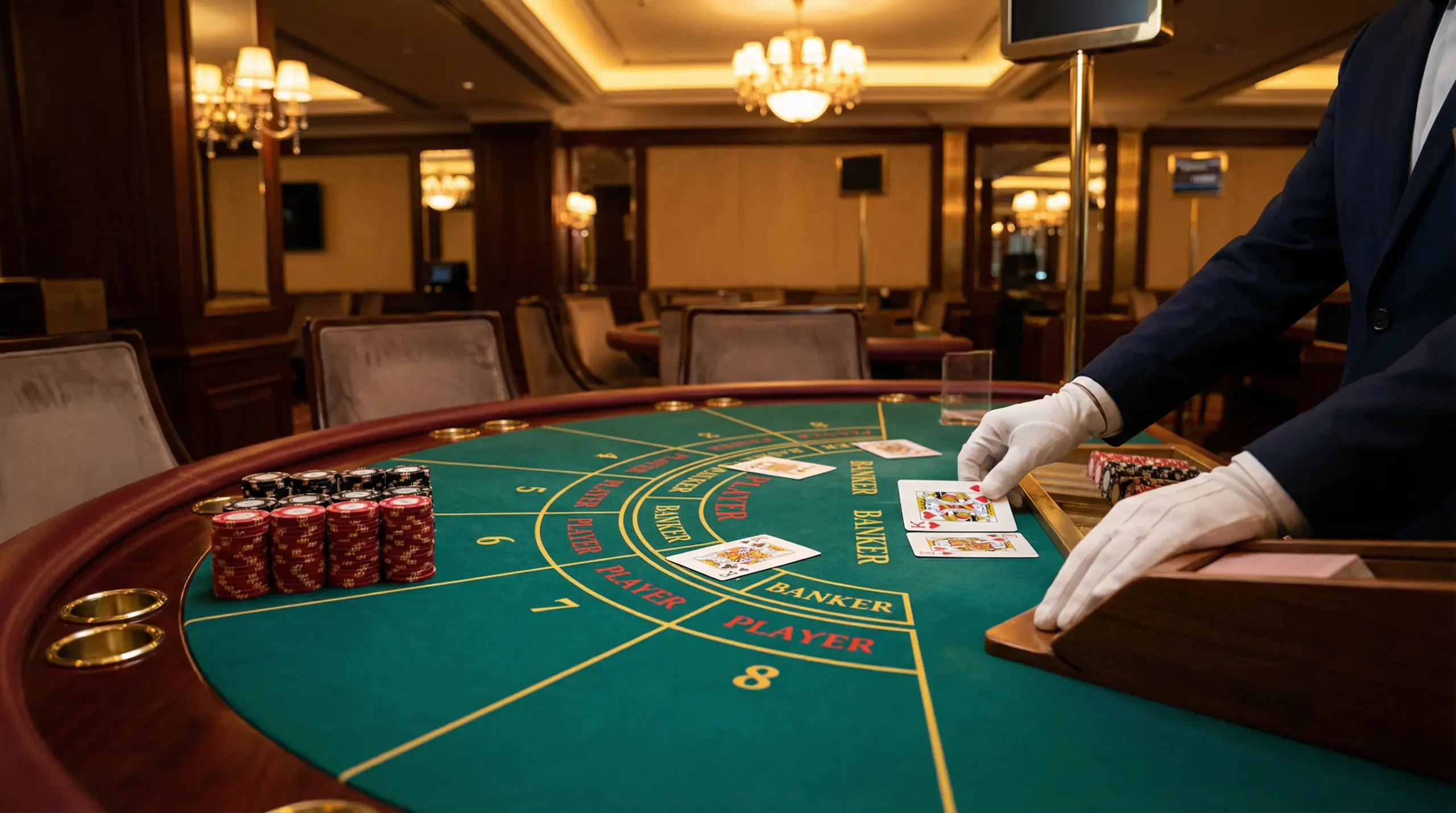
Understanding Baccarat
Baccarat carries an air of sophistication that other casino games simply don’t possess. James Bond played it. High rollers in Macau bet millions on it. Asian gambling culture revolves around it. Yet beneath the mystique lies one of the simplest casino games ever devised—a coin flip dressed in evening wear, requiring zero skill to play optimally.
The game’s appeal to serious gamblers stems from its mathematics. The house edge on the banker bet sits at 1.06%, making baccarat one of the fairest games in any casino. Only blackjack with perfect strategy and certain video poker variants offer better odds. Unlike those games, baccarat demands nothing from you except deciding where to place your chips.
UK online casinos universally offer baccarat in multiple formats. Virtual versions play quickly, letting you grind through dozens of hands per hour. Live dealer tables recreate the casino floor experience with real cards, real dealers, and real ritual. The underlying mathematics remain identical regardless of format—only the atmosphere changes.
Newcomers often feel intimidated by baccarat’s perceived complexity. The truth is simpler: you bet on either Player or Banker, cards are dealt according to fixed rules you never need to remember, and one hand wins. That’s it. The elaborate rituals around squeezing cards and tracking patterns are theatre, not strategy. The game plays itself while you watch.
How the Game Works
Baccarat uses standard playing cards, typically from six or eight shuffled decks. Card values differ from most games: aces count as one, cards two through nine hold face value, and tens plus face cards count as zero. Hand values are calculated by summing the cards and taking only the rightmost digit. A seven and an eight, for instance, total fifteen—but the baccarat value is five.
Each round begins with four cards dealt: two to the Player position and two to the Banker position. These aren’t actual players in any meaningful sense—they’re just labelled betting options. The goal is reaching a total as close to nine as possible. A natural occurs when either hand totals eight or nine from the initial two cards, immediately ending the round.
When neither hand achieves a natural, fixed drawing rules determine whether additional cards are dealt. The Player hand draws a third card if its total is five or less. The Banker hand’s drawing decision depends on both its own total and the Player’s third card, following a tableau that dealers memorise but players never need to know. These rules are automatic—no decisions required.
The hand closest to nine wins. Banker wins pay even money minus a 5% commission (so £0.95 per £1 wagered). Player wins pay even money with no commission. Tie bets pay 8:1 or 9:1 depending on the casino, offering a much higher house edge that makes them mathematically poor choices. The commission on Banker bets exists specifically because that position wins slightly more often than Player.
Understanding why these rules exist helps demystify the game. The drawing tableau was designed to create roughly balanced outcomes while giving the Banker position a slight edge. The 5% commission corrects for this edge, leaving Player and Banker bets with similar but not identical house edges. Tie bets persist because they pay handsomely when they hit, despite being long-term losing propositions.
Baccarat Betting Options
The Banker bet represents the mathematically optimal choice. With a house edge of 1.06% after commission, it outperforms nearly every other casino wager. The commission feels annoying—watching 5% shaved from wins creates psychological friction—but the numbers favour Banker regardless. Serious baccarat players bet Banker almost exclusively.
The Player bet carries a house edge of 1.24%. This slightly worse return comes without commission deductions, making payouts feel cleaner. For recreational players, the difference between 1.06% and 1.24% barely registers over typical session lengths. Both options are reasonable, with Banker holding a marginal mathematical edge.
Tie bets deserve their reputation as sucker wagers. The house edge ranges from 4.84% on a 9:1 payout to a brutal 14.36% on 8:1 payouts. Yes, ties happen—roughly once every eleven hands. Yes, hitting an 8:1 payout feels exciting. No, that excitement justifies neither the edge nor the expectation that pattern-spotting can predict ties. The mathematics are unambiguous: avoid tie bets.
Side bets proliferate at online baccarat tables. Dragon Bonus rewards winning hands by large margins. Player Pair and Banker Pair pay when the initial two cards form a pair. These bets uniformly carry higher house edges than the main game. They exist to generate casino profit, not player wins. Treating them as occasional entertainment is fine; treating them as strategy is not.
Minimum and maximum bets vary dramatically across tables. Virtual baccarat often allows stakes from £1 to £500. Live dealer tables typically start around £5 and extend to five figures for VIP rooms. Choosing tables with bet ranges that match your bankroll prevents the frustration of playing at stakes that feel either trivial or threatening.
Baccarat Strategy Explained
Here’s the uncomfortable truth about baccarat strategy: there isn’t one. The optimal approach is remarkably simple—bet Banker, avoid ties, ignore side bets, manage your bankroll. That’s the entire strategy, and it fits in a single sentence. Everything else you read or hear about baccarat systems is either marketing or delusion.
Pattern tracking, the practice of recording previous outcomes to predict future ones, remains wildly popular despite being mathematically worthless. Casinos provide scorecards and electronic displays showing outcome histories. These tools persist because players enjoy them, not because they provide any predictive value. Each hand is independent. The cards don’t remember what happened before.
The Martingale system—doubling bets after losses—fails at baccarat for the same reasons it fails everywhere. A losing streak eventually exceeds either your bankroll or the table maximum. When it does, accumulated losses overwhelm the small wins from previous sequences. The system feels safe until it catastrophically isn’t.
Positive progression systems fare no better. Increasing bets after wins captures nothing magical about hot streaks—they’re just clusters in random variance. The extra money wagered during “winning runs” is equally likely to be lost during the inevitable reversals. These systems rearrange the furniture without changing the underlying mathematics.
Bankroll management represents the only legitimate strategic element. Deciding in advance how much to risk, setting win and loss limits, and treating gambling money as an entertainment expense rather than an investment—these practices preserve capital and prevent the chasing behaviour that destroys gambling budgets. Strategy in baccarat is about controlling yourself, not the cards.
If strategy can’t help you win, why do serious gamblers play baccarat? Because the house edge is small enough that variance can work in your favour over reasonable timeframes. A player might genuinely win across dozens of sessions through pure luck. This doesn’t mean they’ve discovered a system—it means they’ve experienced the positive side of variance. Enjoy it when it happens, and don’t expect it to continue.
Live Dealer Baccarat
Live baccarat brings the physical casino experience to your screen. Real dealers handle real cards at real tables, with the action streamed in high definition to your device. The social element returns—you can chat with dealers, watch other players’ reactions, and feel the tension as cards are revealed. For many players, this human connection elevates baccarat from clicking buttons to genuine entertainment.
Evolution Gaming dominates the UK live baccarat market. Their tables run continuously from studios in Latvia, Malta, and other locations, ensuring you’ll always find an active game regardless of hour. Playtech, Pragmatic Play Live, and Ezugi offer alternatives with slightly different aesthetics and features. All major UK casinos contract with at least one of these providers.
Speed Baccarat strips away the ritual to deliver more hands per hour. Cards are dealt face-up immediately, with automatic winning declarations and rapid bet windows. Players who find traditional baccarat’s pace leisurely gravitate toward these tables. The mathematics remain unchanged—only the tempo increases.
Lightning Baccarat and similar variants add multipliers to the standard game. Random cards receive enhanced payouts—sometimes up to 8x—when they appear in winning hands. These multipliers create spectacular wins but come with reduced base payouts and higher house edges. The excitement is real; the long-term mathematics are worse than standard baccarat.
VIP and high roller tables cater to serious players. Minimum bets often start at £50 or £100, with maximums reaching six figures. These tables typically feature experienced dealers, faster play, and fewer distractions. The clientele tends toward dedicated players rather than curious tourists. If your bankroll supports it, VIP tables offer a more focused experience.
Squeeze baccarat tables slow the reveal deliberately, allowing dealers (or in some variants, selected players) to peel back cards dramatically. This theatrical element appeals to superstitious players who believe in controlling fate through ritual. The game mechanics are identical—only the presentation differs. Whether squeeze adds entertainment or frustration depends entirely on your temperament.
Choosing a Baccarat Site
UKGC licensing is non-negotiable. Any casino operating legally in Britain must hold a licence from the UK Gambling Commission. This ensures regulatory oversight, fair game testing, and recourse if disputes arise. Offshore sites might offer slightly higher limits or fewer verification requirements, but they operate outside British consumer protections. The trade-off isn’t worth it.
Table variety matters more for baccarat than many games. A good casino offers standard baccarat, speed variants, squeeze tables, and VIP options. Multiple software providers—Evolution plus one or two alternatives—ensure you’ll find a table that suits your preferences. Single-provider casinos limit your options unnecessarily.
Commission rates on Banker bets are standardised at 5% across most tables, but commission-free variants exist. These games modify rules slightly to maintain the house edge without explicit commission deductions. Whether these variants appeal depends on your psychology—the mathematics are comparable to standard baccarat.
Withdrawal speed and payment options deserve scrutiny. Winning at baccarat is meaningless if accessing your funds takes weeks. Casinos processing e-wallet withdrawals within hours exist and should be preferred. Reading user reviews about actual payout experiences provides better information than casino marketing claims.
Bonus terms vary in their applicability to baccarat. Some casinos exclude table games entirely from wagering requirements. Others allow baccarat but weight contributions at 5% or 10%—meaning you’d need to wager twenty times more to clear the same bonus. Read terms carefully before assuming a bonus has value for baccarat play.
Playing Baccarat Sensibly
Baccarat’s simplicity is both its greatest strength and its subtlest danger. Without decisions to make, without strategy to execute, the game can proceed faster than your awareness. An hour of live baccarat might involve sixty hands. At £10 per hand, that’s £600 wagered—with expected losses of roughly £6.50 at optimal play. These numbers can escalate quickly if bet sizes increase or sessions extend.
Setting session limits before you play prevents the drift toward larger bets and longer play that characterises losing gamblers. Decide on a time limit, a loss limit, and a win target. When any threshold is reached, stop. This discipline matters more than any system or pattern-tracking approach ever could.
The attraction of baccarat lies partly in its honesty. There are no complex strategies promising an edge, no systems that work if only you execute them properly. The house has a small advantage, you might win anyway through variance, and luck is the primary determinant of outcomes. Accepting this framework allows you to enjoy the game for what it is: pure gambling, elegantly presented.
Play baccarat because you enjoy it, not because you expect profits. The low house edge means you’ll lose less than at most casino games, but you’ll still lose over sufficient volume. Budget for baccarat as entertainment, appreciate wins when they occur, and walk away with your limits intact. That’s not strategy—it’s just sensible gambling.
Find more game guides at onlinegamblingsitesuk. Also read our live casino guide.